A gym owner weighing up a booking system is usually asking one thing: will my own system be cheaper than paying a software company every month? Usually it will not. Here is the arithmetic we use, with the numbers from the booking engine we built and run.
We do not publish our own prices: a figure on a page fits nobody’s job until we know the job. So this guide leaves our build price out and shows every other number, so you can put any quote, ours or anyone’s, into the same sum.
Four costs, and only two of them change
A booking system costs you money in four places.
- Card fees. Every booking paid by card loses a slice to the payment company.
- Software or hosting. A monthly plan if you buy off the shelf. A hosting bill if you own the system.
- The build. Zero off the shelf. Weeks or months of work if it is made for you.
- Looking after it. Included in an off-the-shelf plan. A support arrangement, or a person, if it is yours.
The first one is the surprise. Card fees barely change between the two routes, so they cannot be the reason to build.
Card fees: roughly the same either way
Stripe, which our engine uses, charges 1.5% + 20p on a standard UK card and 2.8% + 20p on a premium one. ClubRight, a UK gym platform whose prices are on its website, charges 1.85% + 20p on card payments, and 40p to 45p for each Direct Debit collection.
Take an illustrative gym, not a real one: 400 class bookings a month, £10 each, all on standard UK cards.
Card fees on 400 bookings at £10 (illustrative)
Standard UK cards only: Stripe 1.5% + 20p, ClubRight 1.85% + 20p. Premium cards cost more on both routes.
Source: Stripe UK and ClubRight pricing pages, read on 12 November 2026
A gap of £14 a month. That is not nothing over a year, but it will never pay for a build. One thing catches owners out on both routes: when you refund a booking, Stripe keeps its original fee. A generous cancellation policy costs you the fee on every refund, whichever system you use.
Hosting: almost nothing, if it is built for it
Our engine went live on 1 October on Google Cloud. The audit we wrote that morning estimated £20 to £25 a month for it, most of it a database and one server kept warm so the first booking of the day did not wait. On 8 November it moved to Cloudflare (we left Google Cloud for our own products in October for reasons that had nothing to do with price), where the plan costs about £4 a month (it is billed in US dollars), and a small gym’s bookings sit well inside the included allowances.
So once a system is built to run on a platform like this, the running bill is close to a rounding error. That is the honest part of the “own your system” argument. The rest of it is the build.
The build, and the years after it
Our class-booking engine’s first commit went in on 4 June. It took its first live booking on 1 October, 119 days and 1,082 commits later. In the five weeks after launch it had 426 more: small fixes, new options for the owner, and the move off Google Cloud. Nobody should expect a booking system to be finished on launch day.
Most of that effort is not the timetable or the Book button. It is the cases you never think about: two people tapping Book on the last place at the same moment, a payment that succeeds after the customer closed the tab, a refund half an hour before class, a pass bought on the old system. An off-the-shelf platform has met all of those before you sign up. (If you want to see what that work looks like, we wrote up moving a payments database with money in flight.) A custom one has to meet them on purpose.
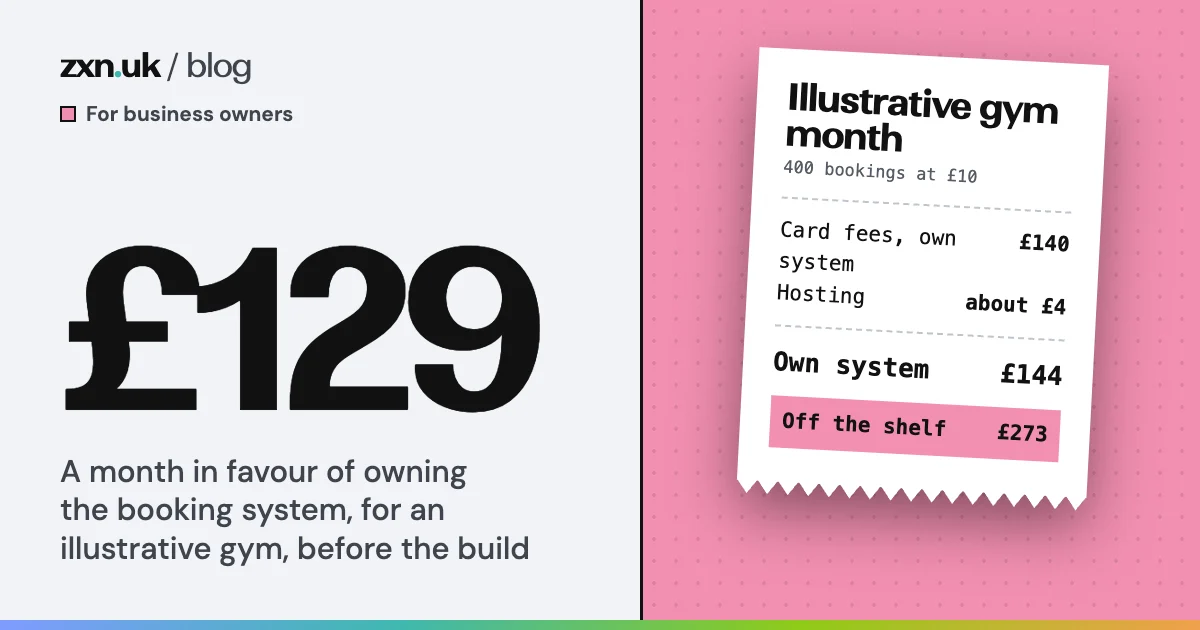
Now set the illustrative gym’s monthly costs side by side, leaving the build out:
Monthly running cost, illustrative gym, build not included
400 bookings at £10 on standard UK cards. Off the shelf: £99 plan, £19.80 VAT and £154 card fees. Your own: £140 card fees and about £4 of hosting.
Source: Stripe, ClubRight and Cloudflare pricing pages, read on 12 November 2026
About £129 a month in favour of owning it, before you pay anyone to build it or look after it. If you are VAT registered you reclaim the VAT, and the gap drops to about £109. Divide any build quote by that gap and you have the number of months before it pays back, assuming the upkeep costs you nothing, which it will not. For a gym this size, on price alone, off the shelf wins.
When building your own makes sense
Price is rarely the reason. These are the reasons we have seen hold up.
Two questions sort most cases. Is there something you need customers to do that no platform lets them do? And do you want the booking pages to be part of your own website rather than a different company’s? If both answers are no, buy the software. If either is yes, it is worth a conversation, and the first thing to ask anyone quoting is how much of the system already exists.
If you run a gym and want a second opinion on a quote, ours or anyone else’s, the button below reaches us. We have recommended against our own build before, and we say so in writing when off the shelf is the better buy.