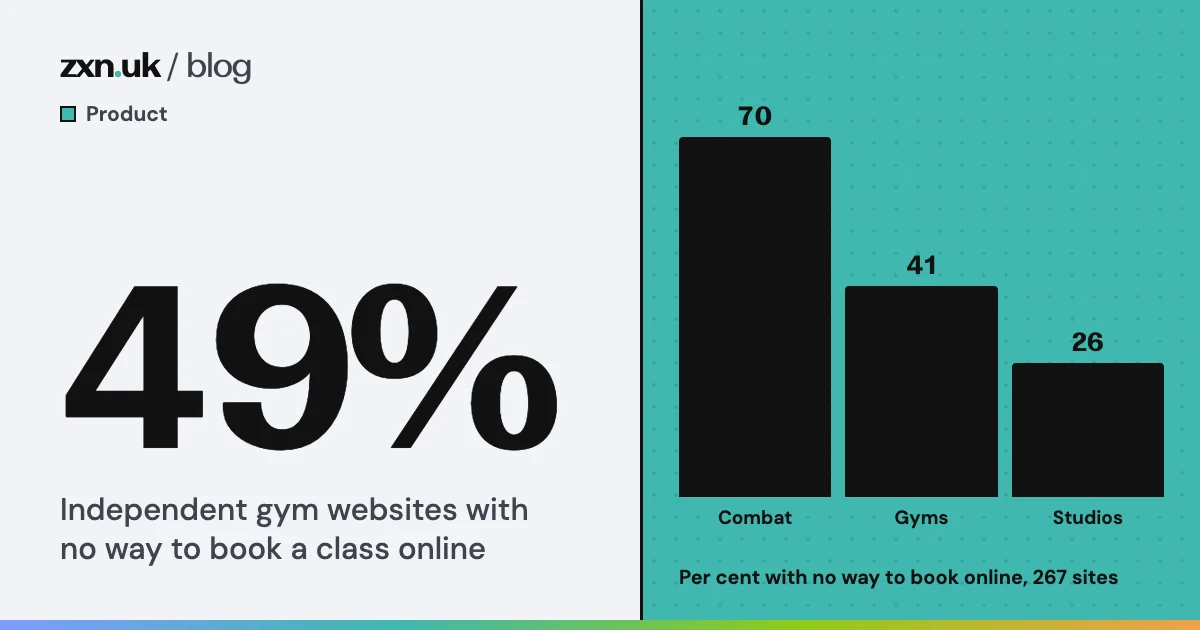
Picture someone on a bus at 5pm who wants to try a boxing class tonight. They search, tap the gym’s website, and look for two things: what is on, and how to get a place. We did that, in a measured way, for 267 independent gyms across the UK. On 131 of them there was no way to book a class online. On many of the rest, the booking page asked them to create an account before they could hold a place.
We build booking systems for gyms (and test them hard: we threw ten thousand generated worlds at one scheduler before launch), so we have an interest in this. That is also why we wanted real numbers rather than our own impressions. As in six months by the numbers, every figure is a count we can point to. This is the first study from zxn.uk Radar, the scanner we run over UK business websites, and the aggregate data is free to download at the end.
What we measured
Radar holds weekly scans of UK business websites linked to Companies House. From it we took every live fitness site and removed chains, franchises, council and trust leisure centres, schools, field and court sports clubs, and businesses filing medium or group accounts. That left 4,623 independent fitness businesses. We drew a reproducible sample of 380 and grouped them into combat gyms (boxing, kickboxing, martial arts), studios (yoga, Pilates, barre, spin, CrossFit-style boxes) and other independent gyms.
For each site a headless browser, sized like a phone, opened the home page and up to three more pages: the first link that looked like a timetable, a booking page and a prices page. It obeyed robots.txt, clicked nothing and booked nothing. 353 sites were readable, and 267 of those were clearly class-led (the rest were one-to-one personal training or gym-floor only). Everything below is out of those 267: 121 combat gyms, 92 studios and 54 other gyms. Combat gyms were sampled more heavily on purpose, so we report each group separately too.
Half cannot take a booking
The split by kind of gym is the most striking thing in the data.
Gym websites where you can book a class online
Share of class-led sites with a booking platform or on-site booking within the pages we read. 267 sites.
Source: zxn.uk gym booking study, 12 to 13 November 2026
Turned the other way round, 70% of combat gyms had no online booking, against 41% of other gyms and 26% of studios. What they had instead was an invitation to get in touch: 48% offered a free trial or taster, 41% a phone link and 13% a WhatsApp link. Eleven combat gyms sent visitors to a third-party trial form, and none of those eleven offered booking as well. That is a deliberate choice for many coaches, who want to meet a beginner before they spar. It also means the visitor on the bus has to wait for a reply before they know whether tonight is possible.
A quarter of all the sites (69) showed neither a timetable nor a way to book. For combat gyms it was 35%.
Where the timetable is
How the timetable is shown
Share of 267 class-led sites. A site can show more than one form.
Source: zxn.uk gym booking study, 12 to 13 November 2026
We expected PDFs to be common. They were not: 3 sites out of 267. The timetable as a picture was the bigger problem, on 28 sites. An image cannot be searched, read aloud by a screen reader or zoomed cleanly on a small screen, and it goes out of date quietly.
Booking usually means leaving, and often means an account
Of the 136 sites that did take bookings, 103 sent the visitor to another company’s domain. The most common single route was not a gym platform at all but Wix Bookings, built into the gym’s own Wix site (26 sites). Then came Mindbody (17), TeamUp (14), Calendly (8), Ashbourne (7), Glofox (6) and Momence (6). Twenty-nine sites used platforms that appeared fewer than three times each: the market is very fragmented.
Most booking routes were close to the front door. On 39 sites the booking screen was on the home page itself, and on 91 more it was one click away.
The friction comes after that click. We checked by hand every platform that served at least three sites, on a public booking page, stopping at the first screen that asked for something. TeamUp, Mindbody, Glofox, Gymdesk and Ashbourne all asked the visitor to sign in or create an account before a class could be held. Wix Bookings, Momence and Wodboard let a guest book with a name and an email (Wodboard’s drop-in form also asked for a date of birth and a full address).
We could not complete the check for Calendly, PushPress, ClubRight and Gymcatch, and did not check platforms used by fewer than three sites. Those 45 sites are left out of that figure rather than guessed.
What we did not find
Apps were not the barrier we thought they would be. Only 11 sites (4%) told visitors they needed an app to book, or used a platform that only books through one. Payment links standing in for booking were rare too (3 sites).
Prices were shown somewhere on 55% of sites, and on the home page of 28%. Combat gyms were least likely to show a price (45%), other gyms most likely (74%).
How fast the pages are
We ran each home page through Google PageSpeed Insights on its mobile setting, which runs Lighthouse on a throttled phone. 263 of the 267 home pages returned a result. The median score was 66 out of 100. Only 37 sites (14%) scored 90 or more, and 45 (17%) scored under 50.
The main content took a median of 7.3 seconds to appear on that test phone. Google counts 2.5 seconds or less as good, and 43 sites (16%) managed it. Combat gyms were a little quicker (median 6.8 seconds) than studios (7.6) and other gyms (8.3). These are lab figures on a deliberately slow connection, so real visitors on good signal will see faster pages, but the order holds: a slow page is the first thing the visitor on the bus meets, before any timetable or booking button.
What we would change first
The data. Download the aggregate figures as CSV: every measure as a count and a percentage, for all 267 sites and for each kind of gym. It names no gym. If you run a gym and want your site left out of future Radar scans, the zxnRadar page says how.
Limits. The sample comes from websites that name a limited company, so sole traders and member-run clubs are under-represented. We read at most four pages, so a timetable buried deeper counts as not found. Detection uses a list of 72 booking, form and payment products; a product not on it counts as no booking. The account check describes each platform’s behaviour on the pages we tried; some platforms let a gym switch guest booking on.