A website on a monthly plan is a reasonable way to buy one. You pay a manageable amount, someone keeps it working, and you can ring them when the opening hours change. It goes wrong when the plan is vague about three things: who owns the site, what counts as a change, and what happens when you leave.
We sell websites this way, so this is not a neutral guide. It is the list we hold our own plan to, with the wording from our public package page and terms, so you can hold anyone’s plan, ours included, to the same list.
The basics every plan should cover
These should be in the monthly fee without argument. If a plan charges extra for any of them, ask why.
- Hosting and the security certificate. The padlock in the browser renews automatically. You should never hear about it.
- Backups, and a straight answer to “how would you restore my site if it broke?”
- Fault repairs and security fixes, whenever they are needed. Our terms say they are not counted against your changes, because a fault is not something you asked for.
- Monitoring, so the person looking after the site finds out it is down before your customers do. Our checklist before a client site goes live shows what we check on day one.
- Search basics: the site set up in Google Search Console, and help with your Google Business Profile. This is housekeeping, not a promise of rankings, and nobody honest promises rankings. What you can measure is enquiries: here is how we tell if a site brings in more.
- An enquiry form, and call and email buttons that work on a phone.
What a “change” is should be written down
“Unlimited changes” sounds generous and usually is not. Unlimited has to be limited somewhere, and if it is not in the plan it is in someone’s patience. A number you can picture is fairer to both sides.
That is our definition, from our package page. Unused changes do not carry over. Bigger jobs are quoted before anyone starts, and nothing extra is charged without your agreement. Your provider’s definition might be different. What matters is that there is one, that it is in writing, and that you know what happens when you ask for more.
Ownership is the part that matters most
When a business leaves its web designer, three things decide whether that takes an afternoon or a month: whose name the domain is in, who holds the accounts, and whether you can take the site with you.
Our terms say your text, images, domain and accounts are yours. Domains and eligible business accounts, such as your Google Business Profile, should be held in your name. If you leave, we give you a copy of your site and hand over the source so it can be hosted elsewhere. Moving it, or any extra technical work, may be quoted.
You do not need to take that from us. Check it for any provider:
- Look up your domain’s registrant. It should be your business, not your web designer.
- Ask who is the owner on your Google Business Profile and Search Console. It should be you, with your designer added as a manager.
- Ask, in writing, what you get if you leave. “A copy of the site” and “the source” are good answers. “The domain, once the contract ends” is a warning.
What should not be in it, or should be priced separately
Some things do not belong in a small monthly plan, and a plan that claims to include them usually means a thin version of each.
Apps, software, automation, booking and payment features, shops and memberships are real projects with their own risks. Our terms quote them separately, and we think that is right: bundling a booking system into a website fee hides what you are paying for and makes it harder to leave either one. Domain registration is also a separate cost on our plan, because it is paid to a registrar, not to us.
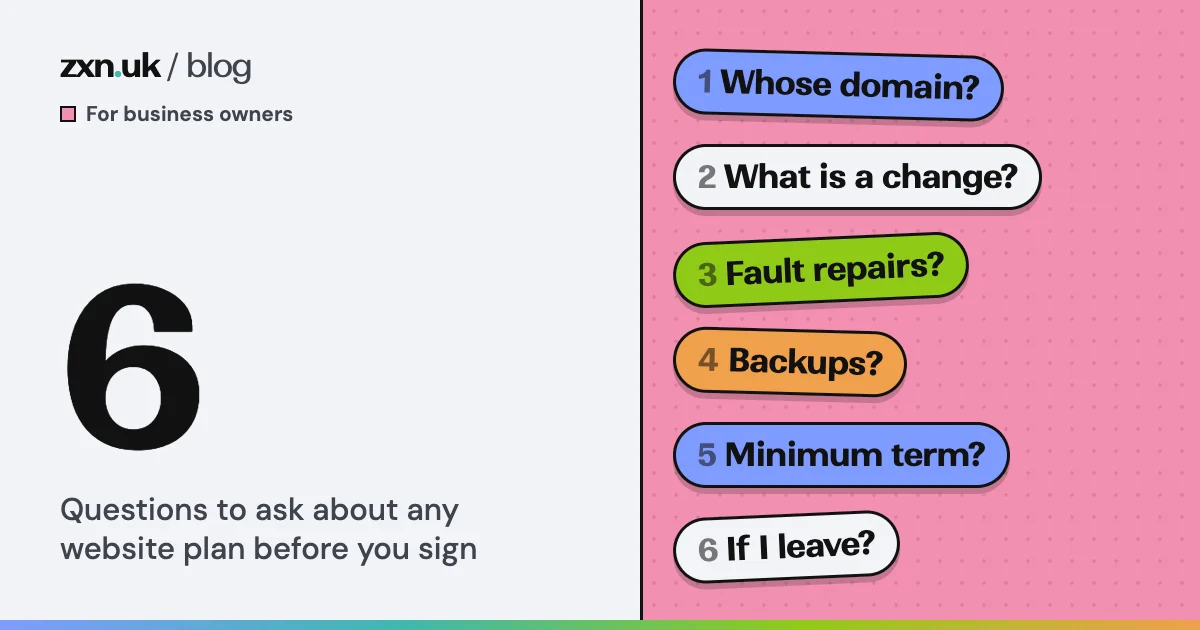
Six questions to ask before you sign
- Whose name is the domain registered in?
- What exactly is a change, and how many do I get?
- Are fault repairs and security fixes extra?
- How are backups taken, and how long would a restore take?
- Is there a minimum term or an exit fee?
- If I leave, what do you hand over, and in what form?
A provider with good answers will give them in a sentence each, in writing. If any answer is vague, ask again. If it is still vague, that is the answer.
If you want our plan, or someone else’s, checked against this list, the button below reaches us. We reply by the next working day.