Google’s advice on SEO fits on a few pages, and most of it is relaxed. There is “no magical word count target, minimum or maximum”. The keywords meta tag is not used. Heading order does not matter for Search. A sitemap is optional for a site of about 500 pages or fewer, if the pages link to each other. The first tip in the guide is to make content people find useful.
So we asked a plain question: do small UK businesses even do the easy parts? On 12 November we checked the homepages of 5,599 of them.
Who we checked, and how
The sites came from our own lists: gyms and martial arts clubs (3,908), tyre fitters (1,191), web and design agencies (313) and accountants (187). That is every site those lists hold: 7,564 domains, of which 6,039 answered. We dropped 440 pages under 3KB (holding pages and redirect stubs) and kept 5,599.
It is a passive check. One request to each homepage, plus robots.txt, the usual sitemap addresses, a made-up address to test the 404 page, and the www or non-www twin. We read the raw page and ran no scripts, so a title added by JavaScript after load would show as missing. 1,525 sites did not answer, and sites that block automated visits are under-represented. These are four trades, not “all small business”, and we report totals only. No business is named.
The basics are missed more than you would think
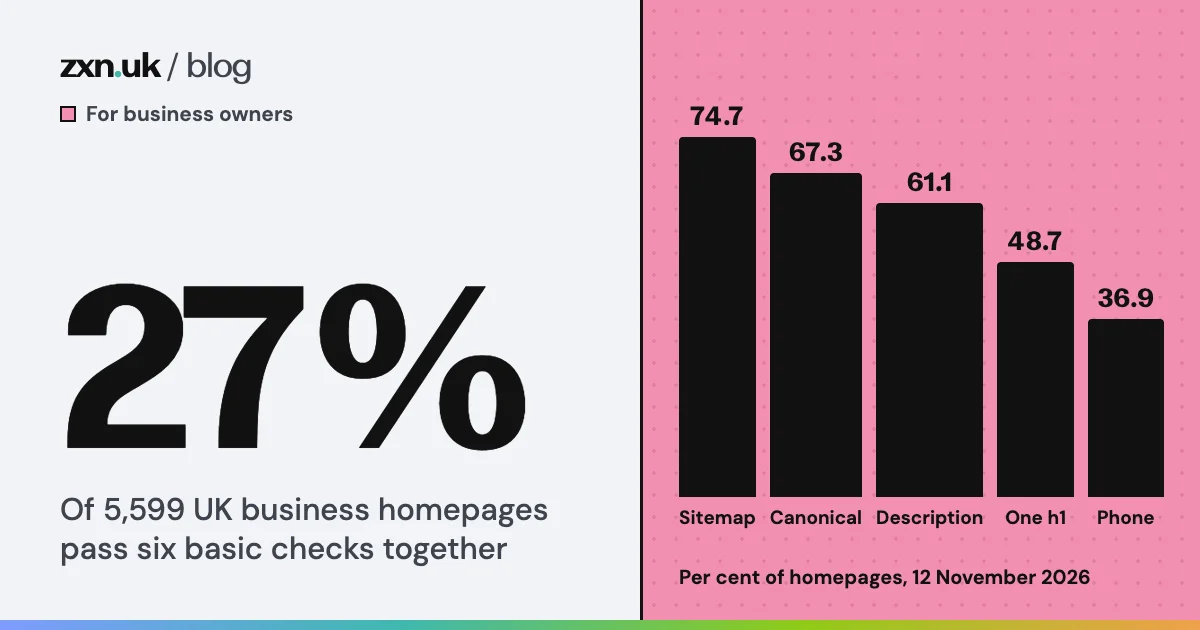
Share of the 5,599 homepages that do each thing
Raw homepage only, 12 November 2026.
Source: zxn.uk's own scan, 12 November 2026
For scale, the HTTP Archive’s Web Almanac 2025 crawled 16,213,084 sites. 98.6% have a title and 91.7% use HTTPS, because platforms do those for you. About 67% have a meta description and 68% a canonical tag. Our small businesses sit near the web at large, a little lower, with the same split: what the platform writes automatically is nearly universal, and what a person has to write is where it falls over.
Add the checks together and it gets starker. Only 49.5% of homepages have a title, a meta description and a main heading all at once. Add a canonical tag, a sitemap, exactly one main heading and a proper 404 page, and just 27% pass the lot.
Some specifics from the scan:
- Gyms trail. 42% have no meta description and 35% no main heading. Web and design agencies are best on almost everything, and still about a quarter have no meta description on their own homepage.
- Images. 58,178 of 90,847 images (64%) have alt text. 76% of the pages that have images have at least one without.
- Two copies of the same site. 13.5% answer on both the www and non-www address as separate copies, instead of sending one to the other.
- Soft 404s. 5.9% serve a normal page for an address that does not exist. A missing page should say so.
- Staying out of Google. 1.1% (about 60 sites) tell search engines not to index the homepage, nearly always a leftover from the build. And 29 of the 4,564 sites with a working robots.txt (0.6%) ask every search engine to stay away from the whole site.
The platform matters more than the trade
On WordPress, 96% of sites have a canonical tag and 95% a sitemap. On Squarespace, 98% have a sitemap and 98% have structured data. On the 2,655 sites we could not tie to a common builder, only 38% have a canonical tag, 54% a sitemap and 29% structured data. Webflow sites had a main heading 98% of the time but a canonical tag only 15%.
Where a site was built tells you more about its SEO basics than which trade it is in. If your site came from a developer who set everything up by hand, nothing was set up for you. That is not an argument against custom sites. It is an argument for checking what they left out.
Cheap things almost nobody does
None of these is a ranking switch, and Google has not asked for them. They cost an afternoon.
- A phone number that is a link. 36.9% overall. Tyre fitters do it 67.2% of the time, gyms 27.8%. On a phone, a number that is not a link is a number you have to copy.
- Opening hours in the page markup. 15.5%. Among sites that do mark themselves up as a local business, only 66% add hours.
- Star ratings in the markup. 2.4%. Only for reviews you genuinely hold and show, and Google limits where it displays them.
- A share image. 49.0% have one, so half of sites show a blank card when a link is pasted into WhatsApp, Facebook or LinkedIn.
- A header that tells browsers to always use HTTPS. 38.6%. On Squarespace and Wix 99% have it, on WordPress 18%.
And one thing to leave alone: FAQ markup is on 4.3% of sites. Google cut back FAQ rich results in 2023, so the low number is the right answer.
The new front door
The Web Almanac found GPTBot named in 4.5% of robots.txt files in 2025, up from 2.9% the year before, and ClaudeBot up from 1.9% to 3.6%. Those count files that mention a crawler, not files that block it. In our scan 12.1% of homepages’ robots.txt named at least one AI crawler: 19.2% of agencies, 13.8% of gyms, 5.9% of accountants. Nobody has to have a policy. But the 88% who have never written one are choosing by default.
Check your own in thirty seconds
We turned the same 18 checks into a free tool. Type your address into the homepage basics check and it shows what passes, what to fix in plain words, and the share of the 5,599 sites that pass each check. Nothing is stored and nobody is emailed. For anything deeper, the free website test and Competitor check on zxn.uk go further. If you have just had a site built, our checklist before a client site goes live and how to tell if it is bringing in enquiries are the next two reads.