The brief for TipBop’s home page asked for a selling point: say that TipBop “takes care of” the tax side of tips. The same sentence ended by asking us to double check the tax implications.
We did the checking first. It came back small. TipBop makes a statement. It does not take care of anything.
A word before we go on. This post is about how we build, not about tax. Nothing here is tax or legal advice, and for that you need an adviser who knows your case. Our plain-English guides to digital tipping start there, and tipping a hairdresser or barber without cash is the one closest to the cases below.
What the checking found
Reading our own code gave two lists. The first is what we can show a person.
- TipBop produces one statement per tax year, in two file types: PDF and CSV.
- It lists every tip that succeeded, with the date, the time and the amount, and it puts both ends of the period in words.
- The years on offer come from each worker’s own first tip, so nobody is shown a year they were not here for.
The second list is what is not true. TipBop files nothing. It withholds and deducts nothing. It is not the payer and not the employer, and it gives no tax advice.
We did not have to guess at that second list, because the statement already prints it. A box on the face of every document says what it is not. It is no official tax document, no payslip and no withholding certificate. A web page claiming the opposite would be contradicted by our own PDF, in the hands of the accountant reading it.
A rule about artefacts, not outcomes
The rule we wrote is short. A public page may describe the document. It may not promise an outcome.
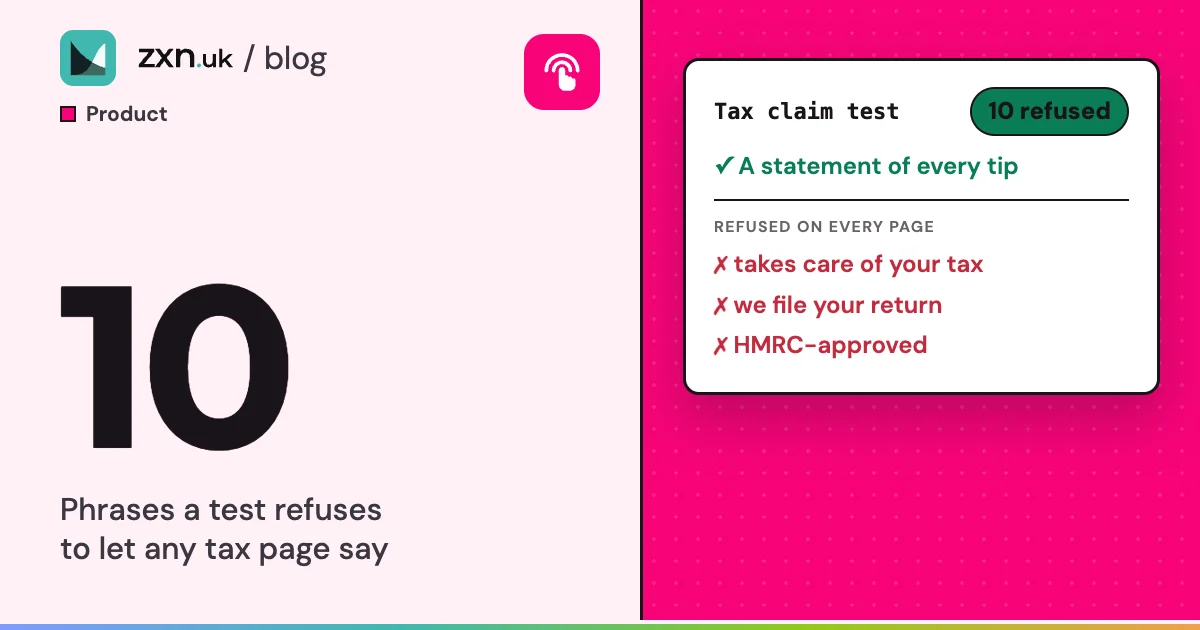
“A statement of every tip, per tax year, ready for your return” is inside the line. Every word can be checked against the code that makes the statement. “Tax is taken care of” is outside it. So is anything that suggests filing, withholding or advice.
A rule like that lasts about a month in a living codebase. Someone new writes the next marketing page without having read the decision record. So we did not leave the rule in a document. It became code, in the same module as the statement.
The test that refused a true sentence
The list holds ten phrase patterns. They catch things like “we file your return”, “takes care of your tax”, “HMRC-approved” and a claim to withhold tax. A test sweeps four reader-facing surfaces for them: the home page, the information pages, the money screen in the app and the legal hub.
The first version had a bug that taught us most. It matched the words “tax advice” anywhere. That fired on the FAQ, on the legal hub and on every statement, all of which say, honestly, that TipBop does not give tax advice. The guard meant to protect the honest sentence rejected it.
A boundary that rejects true statements is one somebody deletes. So the pattern now matches the offer of advice, not the words. And one of the seven checks runs the product’s own approved text through the list and fails if any of it is refused.
Two more checks keep the list honest:
- The list must catch the six sentences the original brief might have produced, written out in full. A sweep that matches nothing looks the same as a clean sweep.
- The pages and the app must say the same tax sentence. The app cannot import the server’s text, so it holds a copy, and the test insists the copy is exact.
There was one more trap, and an older test had already fallen into it. Our page templates are wrapped at about 96 columns, so a sentence is split across a line break and a run of spaces.
A pattern written on one line matched nothing, while the file held the phrase three times. The test now collapses whitespace first. The older test it was modelled on had passed with that bug in it.
The employer who sees nothing
The same habit covers a second claim. The home page says a TipBop account belongs to the person. No employer logs in to it, and no manager gets a screen of it. It is the objection that stops a worker signing up, so it sits near the top.
A page can say that in a minute and be wrong a year later. So a test reads the file that works out the owner’s statistics. It checks that the file still says it has no per-venue rollup, and that no venue id appears in it. The decision record gives a legal reason for that choice, which we leave to the guides. The test only says what follows if that changes. The day a view per venue exists, the sentence on the page is false. The product has changed, not the wording.
The test also protects a near miss. An older line read “Your employer is not involved. At all.” while the terms said to ask your employer first. Each was true. Together they read as a contradiction. The permission paragraph now has to stay directly beneath the reassurance.
What a test cannot tell you
The tax claim test says so in its own header. It cannot check that a claim is true, and it is not an accountant. It checks that no page uses a refused phrase, and that every page says the same sentence.
On 12 September, when the decision record was written, nobody qualified had read it. It says so. The broader claim, that TipBop simplifies your tax, did not ship, because that needs a professional and not a copy edit.