On Saturday 14 November, with Microsoft saying the last regions were back, we searched two of our own documents for four words: Microsoft, Outlook, Microsoft 365, Entra. The architecture standard and the alerts runbook returned nothing. For about a minute that felt like the end of the audit.
It was not, because the place we lean on Microsoft is not in either document. It is on the sign-in screen.
Where the search came back empty
The empty result is real and worth a paragraph. Our sites run on Cloudflare and our apps sit behind it. Our alerts go to Slack and to email, always both, as two paths that do not wait for each other, and neither is a Microsoft service. The quote form on zxn.uk saves each request to our own record before it sends anything. A two-day outage at Microsoft does not stop any of that from running.
It also would not have woken anyone. Since October our paging rule has been that a third-party outage we cannot act on never pages a person, because there is nothing for them to do at three in the morning except watch.
So far, so comfortable. That is usually the point at which to keep reading.
Four doors, and two of them lead to the same place
Our sign-in standard has four methods: a six-digit code sent by email, Apple, Google and Microsoft. Every app shows the email code. Staff tools add Google and Microsoft, with Apple optional, and consumer apps add Apple and Google. We wrote about it in October, and one line in that post is the one that matters here. The email code is on every screen, we said, “because it is how someone gets back in when they lose access to a provider account”.
Now picture the person we built the Microsoft button for: someone at a business that runs on Microsoft 365. Their work identity is a Microsoft account. Their work mailbox is Exchange Online.
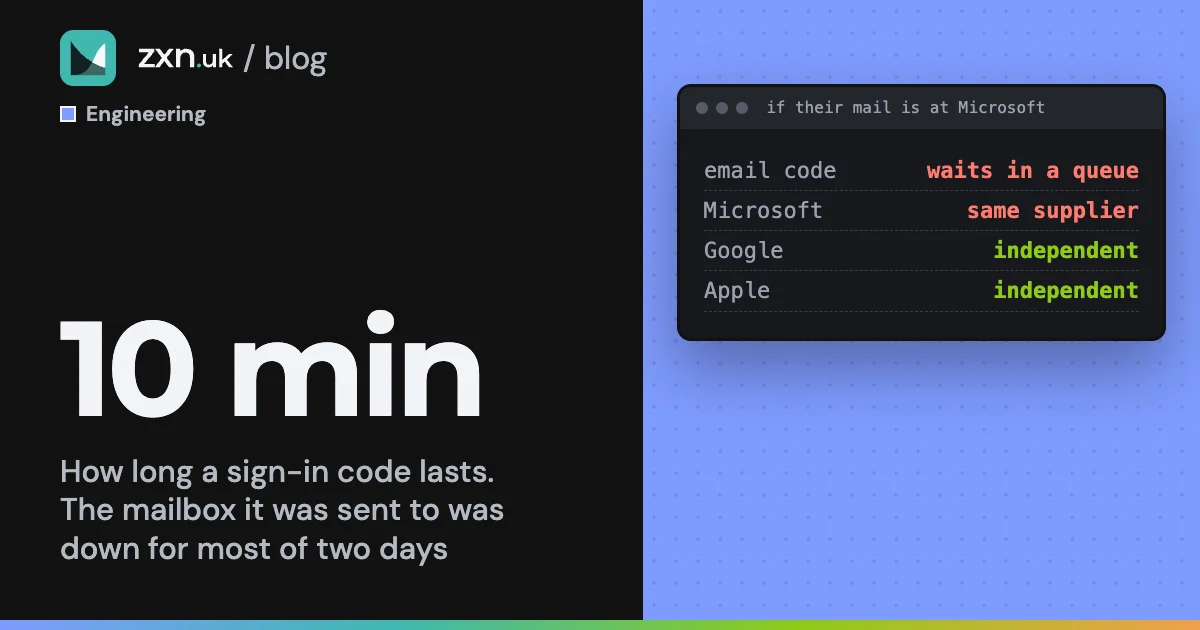
Four ways in, for someone whose mail is at Microsoft
What each sign-in method leans on, and what that meant during the outage.
For a person whose work email is at Microsoft, the button and its fallback are the same supplier. The other two doors only help if they had set one up beforehand, and Apple is optional on our staff tools.
The code lasts ten minutes and works once. During the outage a message to an Exchange Online mailbox could sit in a queue for hours, and Microsoft did not describe the queues as approaching normal until Friday. A code that arrives the next day is not a way back in.
What we do not know
Three things, stated so that nobody reads more into this than is there.
We do not know that Microsoft sign-in itself failed. The services named in the reports, which we wrote up separately, were Exchange Online, Outlook, Teams, SharePoint and Copilot. We have not seen sign-in named, and Microsoft’s own report is not out.
We do not know that anyone was locked out of one of our apps, and the sign-in logs cannot tell us. On 14 November we counted sign-in events for 12 to 14 November against 9 to 11 November, app by app, with nothing but counts read. TipBop recorded 8 sign-ins in the window, none failed and no email code went unused, against none in the days before. ZooLog recorded none in the window and 2 events in all of 9 to 14 November. TyreStack’s last recorded sign-in was on 9 November. Our two internal tools showed almost no sign-in traffic either way, and one app has no production sign-in database yet. That is too little to say whether a held-up code ever mattered. It is a near miss at most, and a finding about the design, not about anyone’s day.
And we do not know how many of our users would be in the picture above. It is the people whose only identities with us are a Microsoft work account and a Microsoft-hosted address. The consumer apps lead with Apple and Google. For the staff tools we build for businesses, it is exactly who the button is for.
What we could do about it
None of these is decided. They are the options on the table, with what we think of each today.
The part we cannot engineer away
The honest comparison is with ourselves. Our architecture standard has a row for a global Cloudflare outage, and it says every product is down, there is nothing to do but wait, and that is an accepted risk. We wrote a whole post about that row. A business with everything at Microsoft made the same bet with a different supplier, and on most days it is a good one.
What separates a slow day from a lost one is whether the fallback shares a supplier with the thing it backs up. Ours did, in one place, and we had written “fallback” next to it.