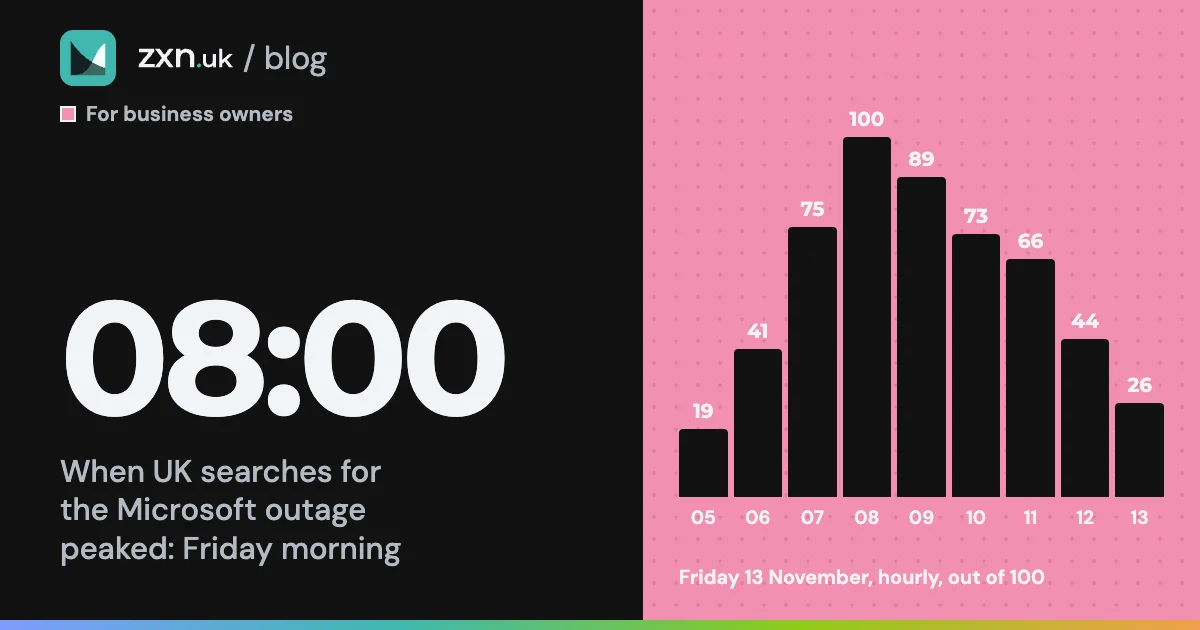
On Thursday evening, with Outlook failing across the world, UK searches for “microsoft outage” sat at about three in a hundred of their later peak. At 8am on Friday they hit 100.
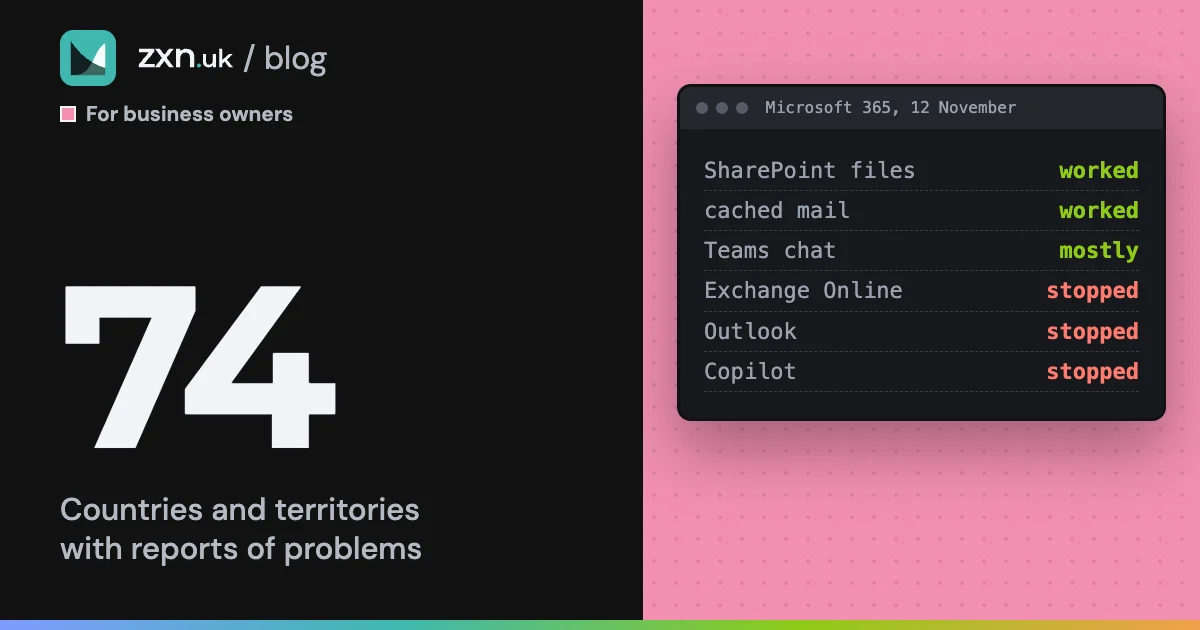
Microsoft acknowledged the problem at 17:54 UTC on Thursday 12 November. We wrote up what stopped and what kept working. This post asks a different question: what did people type into Google, and when? The figures are from Sunday 15 November, so they cover the outage and its first day of aftermath, nothing longer.
Thursday evening: the world looked, the UK was at home
Worldwide, searches jumped in the hour after Microsoft’s first post and stayed high through the night. In the UK the same hours were quiet. Thursday evening was no time to be checking email, and most people were not at work.
Searches for “microsoft outage”, hour by hour
Each line is scaled to its own peak (100). UK time and UTC are the same in November.
- Worldwide
- United Kingdom
Source: Google Trends via the DataForSEO API, hourly, Thursday 12 November 17:00 to Saturday 14 November 06:00, pulled 15 November 2026
The worldwide line is our check on the clock. It jumps at 18:00, the hour after Microsoft’s post, so the hours in this data line up with the real event.
Friday 8am: the working day starts
UK interest began to climb at 05:00 and hit 100 at 08:00. Hourly readings ran 19, 41, 75 and 100 from 05:00 to 08:00, then 89, 73, 66, 44 and 26 to 13:00. By 17:00 it was 7. In the same hour, on the same scale, “outlook down” reached 66 and “is microsoft down” reached 30.
Our reading, which the data does not prove: many UK businesses found out when they opened a laptop. Thursday’s failure had been sitting there overnight. The first person to try sending an email on Friday became the first person to search.
For a small business this is the awkward part. Your customers and staff may learn about an outage at the same moment you do. That is the start of the day, with nobody yet in charge of working out what is wrong.
The biggest week since at least January 2024
We also looked back to January 2024 for the same phrase in the UK. The week of the outage scored 100. The week of the CrowdStrike fault in July 2024 scored 24. Every other week scored 4 or less.
UK searches for “microsoft outage”, busiest weeks
Weekly index, January 2024 to 15 November 2026. 100 is the busiest week in that span. Labels show the day each week starts.
Source: Google Trends via the DataForSEO API, weekly, United Kingdom, pulled 15 November 2026
Teams barely registered. “teams down” peaked at 6 in the same request where “outlook down” reached 56, about a tenth as much. That fits what we reported before: Teams chat mostly kept working, and email did not.
What people asked next
The related searches read like a story told in questions. First came “is microsoft down” and “outlook down”. Then “is outlook still down” and “when will outlook be fixed”. Then “what caused microsoft outage”. By Friday there were searches for a status page, and one for “ofsted email issues microsoft outage”, which suggests public bodies felt it too.
A second group never mentioned Microsoft at all. On Friday “email not working” rose from about 12 to 100 and “email down” from about 4 to 74. These people knew something was wrong with their email and did not know whose fault it was.
Searches about money appeared on the same day. “microsoft sla” and “microsoft compensation” both peaked on Friday, having barely registered in the three weeks before. We have not read what service credits Microsoft’s terms give, so we have no view on what anyone is owed.
What people did not search for was a way out. On the same scale, “microsoft 365 outage” reached 100 on Friday. “microsoft 365 alternative” reached 1.
Friday 13 November: asking what happened, not what next
UK daily index from one request, so the columns compare with each other. The usual level for 1 to 11 November was 4 for “email down”, 9 for “google workspace”, 1 for “backup email” and 0 for the other two.
Source: Google Trends via the DataForSEO API, daily, United Kingdom, pulled 15 November 2026. Full terms: “microsoft 365 outage”, “email down”, “google workspace”, “backup email”, “microsoft 365 alternative”
Two small signs are worth a mention. Searches around “google workspace” included “is google workspace down” and “protonmail”, both rising. Some people may have been checking whether other providers had failed too. The volumes were small, so we would not build much on it.
By Saturday, daily searches were back to between 0 and 5 on the same scale. That was the day Microsoft said service had returned for the last customers. Interest fell back within about a day.
What a small business can take from it
None of this says what you should buy. It does say something about timing and habit.
- Expect to find out at the start of the day. Pick one person to look at Microsoft’s public status page, status.cloud.microsoft, before 8am if anything looks wrong. Microsoft documents it for when you cannot sign in to the admin centre.
- Give staff a sentence to say. Many searchers did not know it was Microsoft. A line such as “email is down for everyone, we will message you on WhatsApp” saves everyone from searching alone.
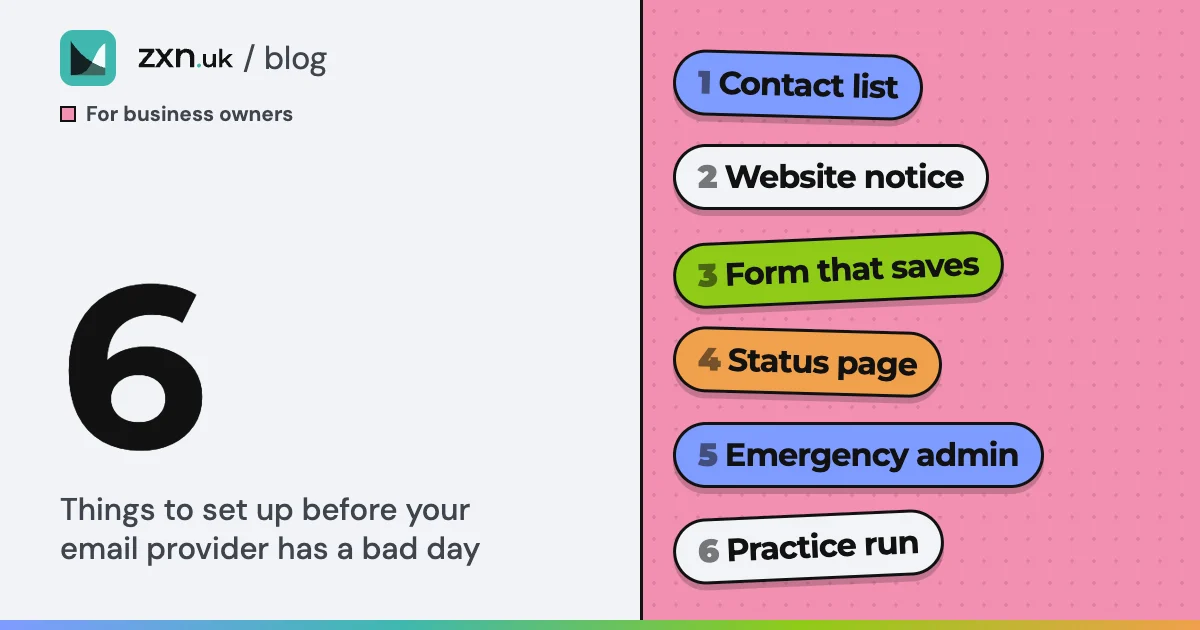
- Choose your second way before the day. Almost nobody searched for alternatives during the outage, which suggests the moment is too late to start. Our checklist for the quiet day is a short place to begin.
- Keep a note of the times. If you later ask your reseller or Microsoft about credits, a record of when you lost mail will help. We have not checked what is owed.
What this data cannot tell us
Google Trends gives an index, not a count of searches. Low values are rounded, so a small term can show as nothing. It covers Google only, and only up to the day we pulled it. We could not reach forums or comment threads, so we cannot say what people said to each other, only what they typed. Microsoft had not published its full incident report when we wrote this, so the cause is not settled either.
Last, our readings of why searches moved are readings. The numbers are what the tool returned. If you can see a better explanation, we would like to hear it.