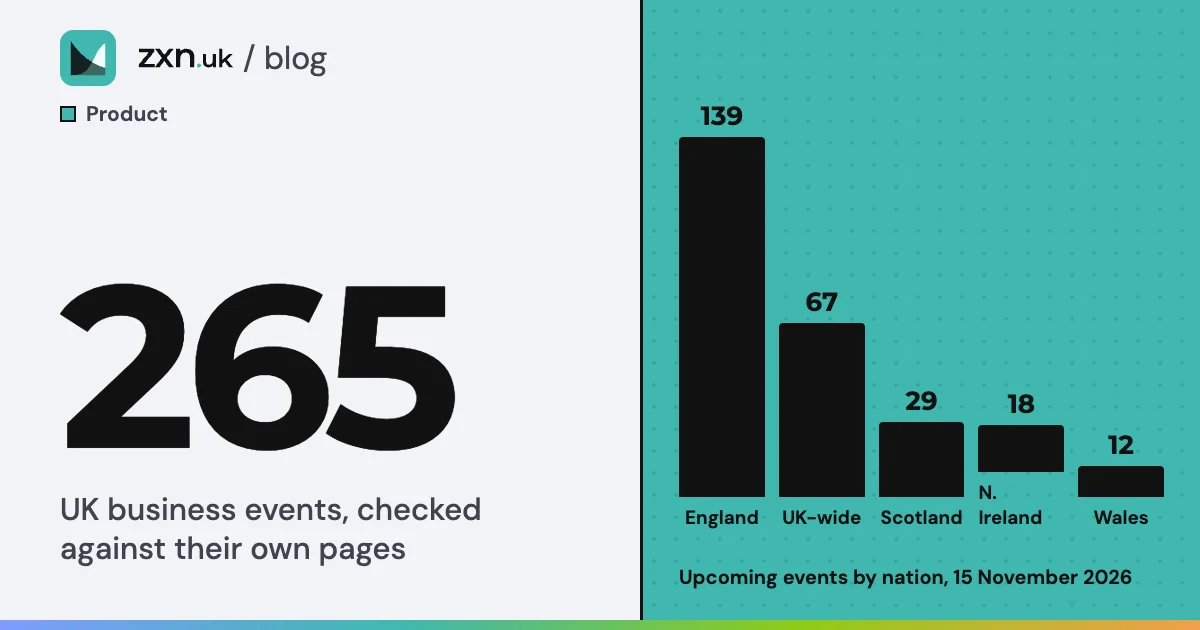
On Sunday 15 November we had 265 upcoming business events in a database. Each had a date, a place, a price where the organiser states one, and a link to the page it came from. Every one had been compared with that page at least once.
That is the whole product: a free finder for UK business events. Search by town or postcode and a distance, by region, sector or date, or just free and online events. Every card sends you to the organiser to book. We do not take bookings, and we do not copy their descriptions or pictures.
Why bother
If you run a small business in Kent or Fife, the events that could help you sit on many different sites. Your chamber has some. So do your council, a trade body, a growth hub and a university. No one page shows them all. Eventbrite and Meetup help, but their terms do not let us copy their listings, and much of what a chamber runs is never on them.
So the first job was not code. It was reading the terms. We looked at 86 calendars. 27 are switched on, because they publish a feed, or markup on each event page, and their terms allow reuse or say nothing against it. The rest are off. Some forbid copying. Some ask us to write first. We have drafted those requests, and they go out under a director’s name. We will switch each calendar on only when it says yes.
How it is built
A Cloudflare Worker wakes up every half hour in the early morning and does one step at a time. We picked Cloudflare knowing where it can fail us. It reads the next few calendars and drops anything in the past. It sends the new events to Claude in batches of 20 to work out the sector, the topic, the audience and whether it is online.
It then opens each event’s own page and checks the date and that the event still stands. Once a day a stronger model reads a random sample of 12 pages and tells you, and us, whether our facts match. A service that says it is healthy can still hold bad data, as one of our own checks once showed.
AI does the boring middle: tidying titles and deciding the sector, the topic and who an event is for. It does not make up dates. Dates, places and prices come from the organiser’s own data. If their page disagrees with our copy, we change ours or drop the event.
The first day cost $0.32 in API charges: $0.11 for the tagging and $0.22 for the daily checks. We set a hard cap of $6 a month. If it gets near the cap, the pipeline stops calling the model and uses plain rules.
Where the 265 events are
Upcoming events by nation, 15 November 2026
Source: zxn.uk events finder database
What went wrong on day one
Our first quality score was 74 out of 100. The second-pass model marked 6 of 12 sampled events as wrong. Five were prices: we had stored “price not known” and the model, reading a page that did state a price, said we were wrong. That is a gap, not a falsehood, so we now count it as a gap and show “Price on the event page”.
The sixth was real. A webinar from a safety body had no venue in its data, so we showed it as in person. We now read the page’s own words when the data gives no place.
When nothing says online either, a card shows “Place on the organiser’s page”.
After the fixes we cleared those six and sampled again. By the end of the day the second-pass model had read 57 records. 54 matched our copy, 2 it could not settle, and 1 was wrong. The wrong one was a funding course run online by Zoom that also listed a postcode, so we had called it in person. We now trust a page that says it is online. The quality score for the day was 97 out of 100.
We then drew 50 events across every nation and sector we cover. For each one we opened the organiser’s page and compared title, date, place and price. All 50 had the right title and date, and a working link. Three had a place that we could not find on the page. Only 5 showed a price we could match, because most organisers do not put one in their data. A card with no price says so, and links you to the page.
We then added Scottish sources and a reader for event feeds. We also added a rule that reads a price from the page when the data has none. A second sample of 50 had the same result on title, date and link. We found the place on the page for 47, and matched a price for 12.
What it cannot do yet
Scotland and Wales are still thin. Scotland has 29 events and Wales 12, which is not a fair picture of either. Most Scottish and Welsh bodies either forbid reuse, ask us to write first, or have no feed we can read. We would rather show a few you can trust.
One chamber calendar in South Yorkshire used to supply a third of all the events. Many were first aid and health and safety courses. We now show at most 40 from it, and no more than 3 dates of one repeating course. The rest are kept, hidden, and come back as places free up.
We also do not read Eventbrite or Meetup, and we will not. If you run events and want yours listed, write to [email protected] or send us your calendar address. If you do not want them listed, write to the same address and we will take them down within two working days.
Get the events by email
You can save a search, such as “free events within 25 miles of Canterbury”, and get a daily or weekly email when new ones appear. The same box signs you up to this blog: as each post goes live, or weekly, or monthly. Both use double opt-in, one tap to stop, and one list kept by us. Choose what you want.